How to Build a Closed-Lost Revival Funnel

If you look at most high-functioning sales teams, AEs are completely backlogged with in-flight deals.
They’re doing the right thing: focusing on opportunities that are already active.
The best AEs also know they should go back and revisit people they’ve talked to before. They look for situations where timing wasn’t right, budget wasn’t there yet, or the prospect was locked into a competitor but said “check back later.”
They follow up on change events. They nurture thoughtfully. They stay top of mind.
But most teams aren’t made up entirely of A-players.
They have B-players who could become A-players with the right structure, guidance, and process. Without that, closed-lost work becomes inconsistent, reactive, and poorly timed.
The most common failure mode looks like this:
- Reps don’t work closed-lost on the buyer’s schedule
- They work it on their own schedule
End of quarter hits. Pressure mounts. Reps blast everyone who said “no” last quarter.
The buyer didn’t suddenly need your product just because you need to hit your number.
That’s the core issue.
Let’s break down how teams actually try to do this today, why it fails, and what a repeatable closed-lost revival funnel really looks like, from fully manual to fully automated.
How to Build a Closed-Lost Revival Funnel
Level 1: The Fully Manual Approach (The Bare Minimum)
The most basic closed-lost “system” looks like this:
Once a quarter, the VP of Sales sits everyone down and says:
“We’re going to spend a day going through old closed-lost accounts in the CRM.”
Reps filter for closed-lost deals, skim the reason fields, and manually reach out.
This happens four times a year.
And that’s it.
The problem isn’t effort. The problem is timing.
You’re doing this when you feel like doing it, not when anything meaningful has changed in the buyer’s world.
Most of the time, when you follow up, nothing has changed:
- No new budget
- No new priority
- No new stakeholder
- No new pain
Or worse, the event that did change things already happened months ago, and you missed it.
This approach is flawed, but it’s the minimum most teams can start with.
Level 2: Basic Automation (Still Missing the Moment)
The next level up is basic RevOps automation.
When a deal is marked closed-lost in Salesforce or HubSpot, the associated contacts or champion get dropped into a nurture.
Every three months, a task is created for the rep:
“Follow up with closed-lost deal.”
This is slightly better than quarterly CRM archaeology, but it still has the same fundamental issue. It lacks context.
It’s just a more automated version of guessing.
Nothing about the buyer’s situation has changed. You’re still reaching out because a clock went off, not because something actually happened.
Level 3: Working Closed-Lost on Buyer Timing (and How AI Can Help)
This is where things actually get interesting.
Today, it’s possible to take all of the context from a closed-lost deal and use it properly:
- CRM close-lost notes
- Call transcripts from Gong or similar tools
- Emails logged in your CRM
- Objections, blockers, and “check back later” moments
Instead of just knowing that a deal was lost, you understand why it was lost.
More importantly, you know what needs to change for that deal to become relevant again.
For example:
“Our contract expires in September. We want to give our current vendor a fair shot until then.”
Most reps either:
- Set a calendar reminder six months out and forget why it exists
- Or forget entirely
AI can pull that context forward, continuously monitor for change, and surface the opportunity when it actually matters.
You can look externally:
- Hiring changes
- Leadership changes
- Product launches
- Contract renewal timing
- Budget cycles
And then reach out only when something has shifted.
This lets you send communication that is:
- Highly contextual
- Time-sensitive
- Clearly relevant
We Have This System Ready for You
What we do at Letterdrop is essentially operationalize this third level.
We use AI to analyze:
- CRM deal data
- Call notes and transcripts
- Emails
- Stakeholders involved
- Objections and blockers
We identify what stopped the deal, what needs to change, and then track for those changes.
If nothing has changed, we don’t push outreach.
If something has changed, we trigger highly contextual follow-ups at the right time.
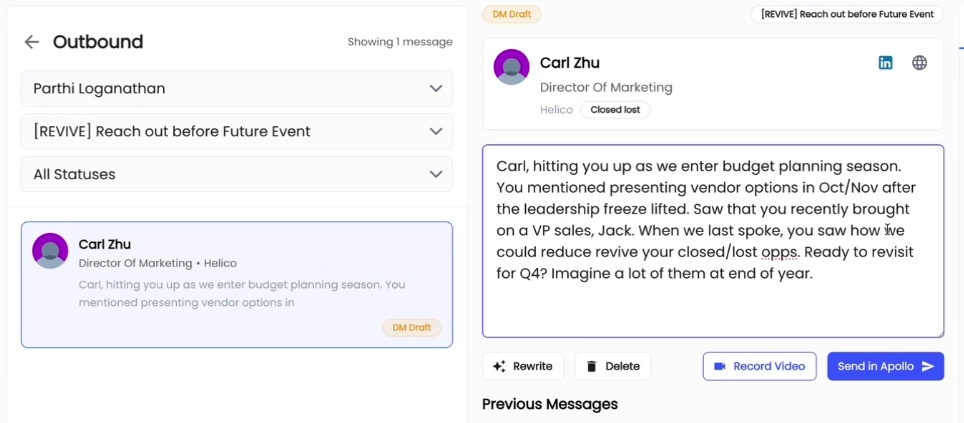
It’s largely plug-and-play as long as:
- You have closed-lost deals in your CRM
- You have some form of recorded sales context
The result is a closed-lost revival process that’s:
- Consistent across reps
- Aligned to buyer timing
- Low effort for the sales team
What Good Closed-Lost Outreach Actually Looks Like
When done correctly, closed-lost outreach sounds like:
- Checking in right before a renewal
- Following up because a previously missing feature or integration is now live
- Re-engaging after a budget refresh
- Reaching out once a new decision-maker is in seat
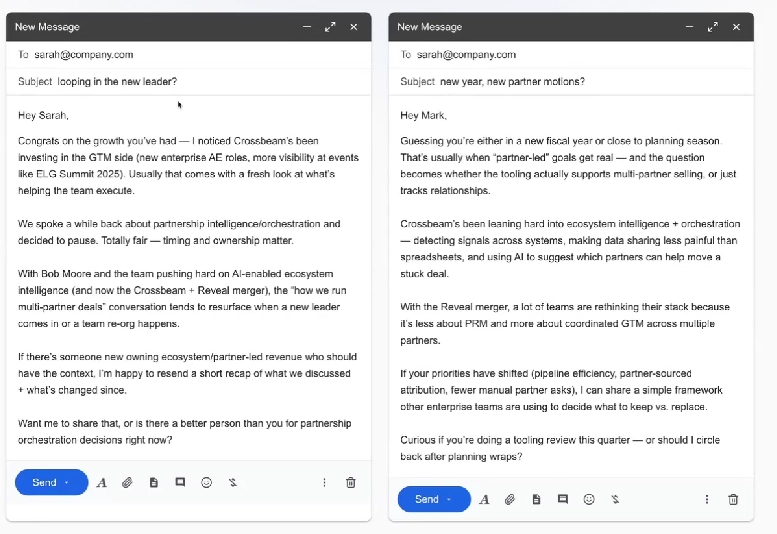
These are messages most AEs aren’t sending today unless they’re extremely disciplined and organized.
Not because they don’t care, but because staying on top of this manually is hard.
With the right system, it becomes standard.
The ROI Math: Why You're Leaving Money on the Table
Here’s how to think about the opportunity.
Let’s say you’ve talked to 2,000 companies over the last couple of years.
Your average ACV is $50–55K.
Assume a conservative 20% close rate.
That’s $2M+ in win-back revenue.
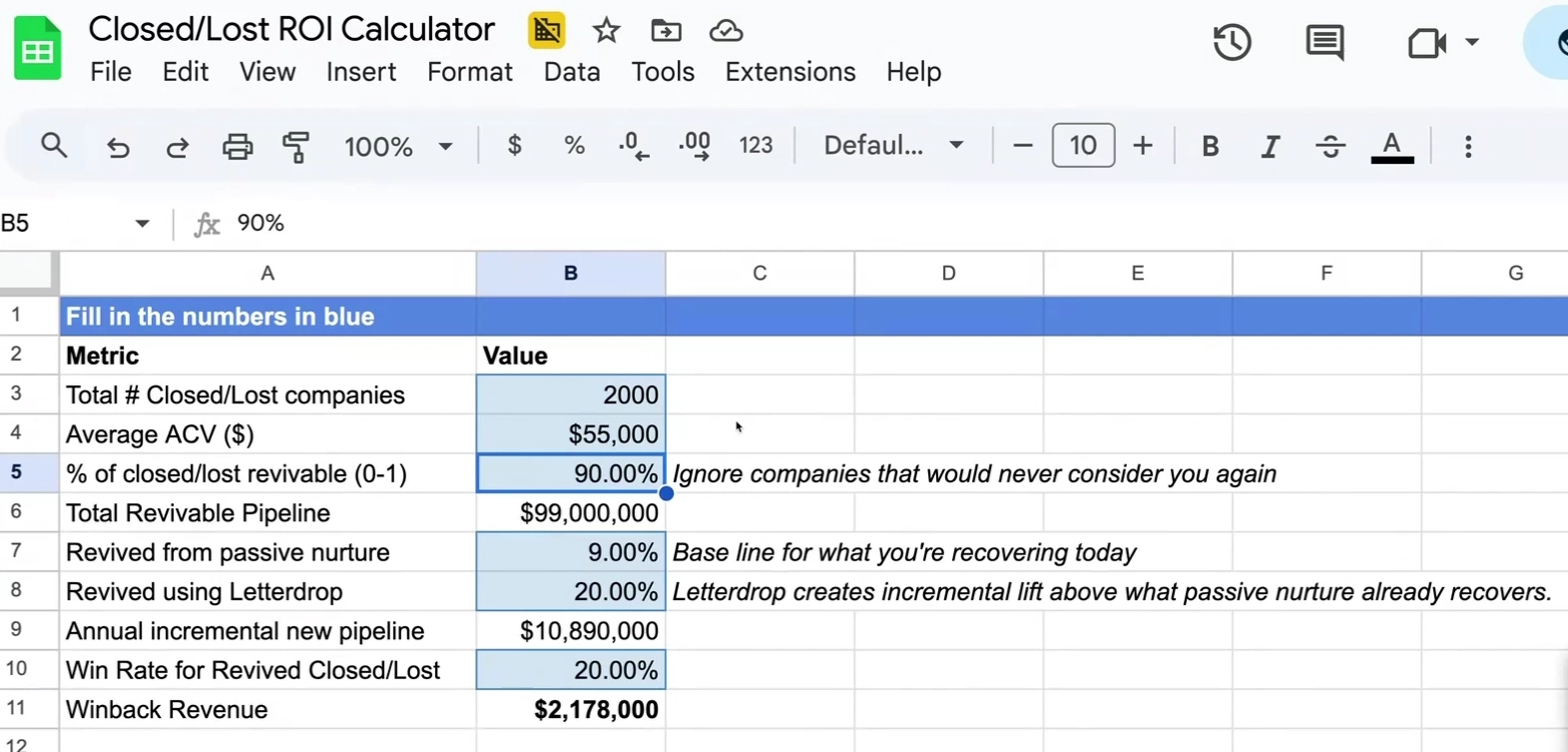
And importantly:
- You didn’t ask BDRs to do more outbound
- You didn’t run more ads
- You didn’t add events
- You didn’t increase spend
You just worked deals you already earned the right to revisit.
For most CROs, the question isn’t whether this is real.
It’s whether it’s meaningful enough to systematize.
Final Thoughts
If your company has been around for even a year or two, you almost certainly have far more pipeline potential in closed-lost than you realize.
Most teams just don’t have a system that respects buyer timing.
Build one manually if you have to.
Automate pieces where it makes sense.
But if closed-lost is more than a quarterly checkbox for you, it deserves a real funnel.
Because the cheapest pipeline in your company is the one you already paid for.
Subscribe to newsletter
No-BS GTM strategies to build more pipeline in your inbox every week
Related Reading
Some other posts you might find helpful