Closed-Lost Win-Back Email Templates (By Loss Reason)

Generic "just checking in" emails don't reopen closed-lost deals. If you lost a deal because of a budget freeze and your follow-up doesn't acknowledge that, the prospect sees another cold email and ignores it.
The loss reason should shape everything about the message: the timing, the angle, and the ask.
This guide gives you ready-to-use email templates organized by the most common closed-lost reasons, along with guidance on when to send each one and what to avoid.
If you prefer shorter-form outreach, we also have DM templates for reviving closed-lost deals that follow the same principles.
Why Loss Reason Matters for Win-Back Emails
Most teams blast the same re-engagement email to every lost deal. That's a mistake for a few reasons.
A prospect who chose a competitor is in a completely different headspace than someone whose budget got cut. The competitor buyer has already committed to an alternative and needs a reason to reconsider. The budget buyer may still want your product but needs the financial situation to change first.
Segmenting your win-back outreach by loss reason gets you two things: higher reply rates (because the message is relevant) and better timing (because you can align follow-up cadence to the reason).
Before writing any templates, make sure your CRM actually captures useful loss reasons.
Templates by Loss Reason
1. Budget Freeze / No Budget
When to send: 60 to 90 days after the deal closed, or when you know budgets typically reset (start of fiscal year, beginning of Q1/Q3).
Subject: Quick question on timing
Email:
Hi {{First Name}},
When we last spoke, the main blocker was budget allocation — your team was prioritizing other initiatives for the quarter.
I wanted to check whether that's shifted at all heading into {{quarter/year}}.
We've also made some changes on our end that affect pricing flexibility, so it might be worth a quick conversation even if the full budget isn't there yet.
No pressure either way. Happy to reconnect whenever the timing makes sense.
Best, {{Your Name}}
Why this works: It references the specific reason, doesn't pretend the conversation never happened, and hints at a new angle (pricing flexibility) without being pushy.
2. Went With a Competitor
When to send: 6 months after close, or when you detect signals that the competitor relationship may be souring (contract renewal window, leadership changes at the prospect, negative sentiment about the competitor online).
Subject: How's {{Competitor}} working out?
Email:
Hi {{First Name}},
It's been about six months since your team went with {{Competitor}}, and I wanted to check in.
We've heard from a few companies in your space that {{specific pain point competitor is known for — e.g., "implementation took longer than expected" or "reporting hasn't been as robust as promised"}}. Curious whether that's been your experience or if things are going well.
Either way, no agenda here. If you're ever evaluating alternatives down the road, I'd be happy to show you what's changed on our side.
Best, {{Your Name}}
Why this works: It's not bitter about losing. It opens a conversation by referencing a real, known weakness of the competitor. If the prospect is having issues, this gives them permission to say so.
3. Timing / Not a Priority Right Now
When to send: At the exact timeframe the prospect mentioned. If they said "revisit in Q1," send the email the first week of Q1.
Subject: Circling back on {{topic}}
Email:
Hi {{First Name}},
Last time we connected, you mentioned this would be back on the radar around {{timeframe they gave you}}. Figured I'd check in rather than assume either way.
Are you actively looking at this again, or has the timeline shifted?
Happy to pick up where we left off or start fresh if priorities have changed.
Best, {{Your Name}}
Why this works: It's direct, references their own words, and gives them an easy path to either re-engage or push the timeline without feeling cornered.
4. No Decision / Went Dark
When to send: 30 to 45 days after the deal went silent. These deals didn't actively choose an alternative, they just stalled.
Subject: Did I lose you?
Email:
Hi {{First Name}},
I realize our conversation kind of trailed off, and I'm not sure if that means the project got shelved or if something else came up.
I'd rather know where things stand than keep following up into the void. If this isn't a fit right now, totally fine — just let me know and I'll stop reaching out.
If it is still on your radar, happy to pick things back up.
Best, {{Your Name}}
Why this works: The "breakup" framing gives the prospect permission to say no, which paradoxically increases response rates. People who ghosted often reply to this because it's low-pressure.
5. Lost to No Decision (Internal Resistance)
When to send: 45 to 60 days after the deal closed. Often a new champion or leadership change will reopen the window.
Subject: New angle on {{the initiative}}
Email:
Hi {{First Name}},
When we last spoke, you mentioned that getting internal alignment was the main challenge — the team was interested but leadership wasn't ready to move.
I've been working with a few companies in similar situations, and one thing that's helped is {{specific resource: ROI framework, one-page business case, peer reference}}. Thought it might be useful if this comes back up internally.
No pitch — just sharing in case it helps move the conversation forward on your side.
Best, {{Your Name}}
Why this works: It positions you as a resource, not a salesperson. By offering something that helps the champion sell internally, you're re-entering the deal without applying direct pressure.
6. Product Gap / Missing Feature
When to send: When the feature ships, or within 30 days of a relevant product update.
Subject: We built the thing you asked for
Email:
Hi {{First Name}},
Quick update — when we spoke in {{month}}, one of the blockers was {{specific missing feature}}.
We shipped that last {{week/month}}. Here's a quick overview: {{one sentence on what it does}}.
Would it be worth a 15-minute call to walk through it? I know the rest of the product was a strong fit — this might close the gap.
Best, {{Your Name}}
Why this works: It's the easiest reopen in sales. The prospect already liked the product; they just needed this one thing. Now they have it.
What to Avoid in Win-Back Emails
A few patterns that kill re-engagement:
"Just checking in" with no context. If your email could be sent to anyone, it's not a win-back email. It's spam.
Pretending the previous conversation didn't happen. The prospect remembers. Acknowledge it and use the context.
Leading with your product updates when the loss reason was timing or budget. They don't care what you shipped if they still can't afford it. Lead with the reason they left, not what's new on your end.
Sending too early. If a deal closed lost two weeks ago because of budget, emailing them now feels desperate. Respect the timeline.
Automating Win-Back by Loss Reason
Running this manually is possible with a small pipeline. But once you have 50+ closed-lost deals with different reasons and different timelines, it breaks down fast.
The process ideally looks like this: your CRM captures the loss reason during close, that reason triggers a follow-up sequence with the right timing and messaging, and reps get notified when it's time to re-engage.
Before you start building that system, it helps to know the size of the opportunity.
Our free closed-lost pipeline teardown calculates your estimated recoverable pipeline in dollars, generates sample win-back emails tailored to your company, and scores where your current process sits. Takes about 60 seconds.
And when you're ready to put the whole thing on autopilot, we can do that for you over at Letterdrop.
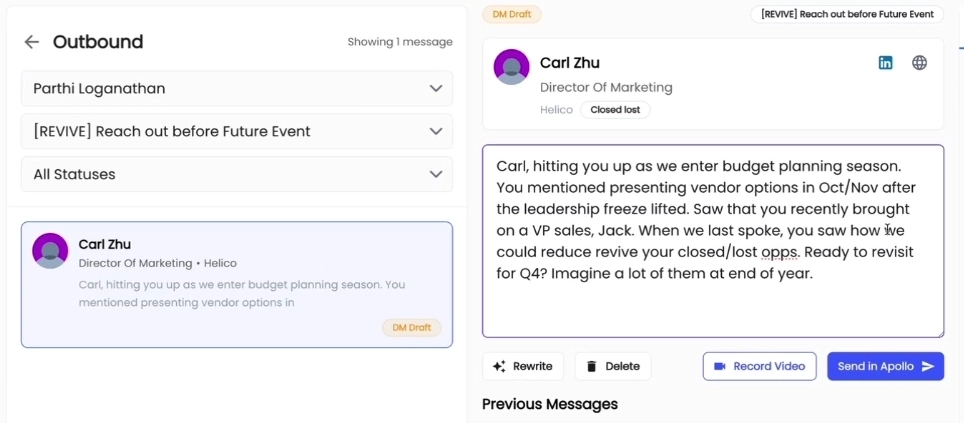
Automatic messaging for closed-lost, with context
Subscribe to newsletter
No-BS GTM strategies to build more pipeline in your inbox every week
Related Reading
Some other posts you might find helpful