Champion Job Change Alerts for B2B Sales and CS Teams

A past champion joins a new company. They already know your product. They like it. They have budget authority in their new role. And you find out three months later, when they have already signed with a competitor who caught it first.
This is happening to your team right now. The question is how many times a week.
Why Champion Job Changes Are Such High-Value Signals
When a contact who has previously bought from you, championed your product internally, or been deeply involved in a past evaluation moves to a new role, a few things are usually true:
• They come with credibility and trust already established. You are not a stranger.
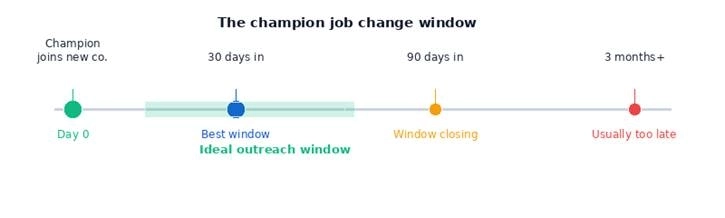
• They are in their first 30-90 days, which is the window where they are most likely to bring in tools they know work.
• They often have fresh budget and the political capital to make quick decisions.
• They are actively thinking about the problem your product solves.
Research consistently shows that warm inbound converts at significantly higher rates than cold outbound. A past champion at a new company is as warm as it gets.
The Problem: Most Teams Find Out Too Late
The typical pattern: a rep notices in the CRM that someone's job title changed. Or a customer success manager mentions in a meeting that their main contact left. Or the champion themselves reaches out months later.
By that point, the window is often gone. They have either made a decision without you or built enough internal relationships at the new company that starting fresh feels harder.
The teams who win on champion job changes are the ones who find out first. Not through a CRM audit or a chance scroll, but through a signal that surfaces the change the moment it happens.
How Champion Job Change Tracking Works
The basic workflow: you maintain a list of past customers, past champions, and key contacts from previous evaluations. When any of those contacts changes roles or companies, you get a notification with the context you need to act. Who moved, where they went, and what you know about their history with your product.
Letterdrop surfaces these signals automatically. When a past champion joins a new qualified company, it flags the contact, pulls together their history with your account, and can draft the outreach context so your rep is walking in warm.
The goal is not to reach every ex-contact. It is to reach the right ones, with the right context, at the right moment.
How to Reach Out When a Champion Moves
The first message matters. A few principles:
Reference the History Honestly
Do not pretend you happened to notice them. A line like "Saw you just joined [company]. Congrats on the new role" is fine. It is honest, it is warm, and it signals you are paying attention.
Keep It Light in the First 30 Days
The first month at a new job is chaotic. A simple "congrats, would love to reconnect when you are settled in" is often more effective than a full pitch. You are planting a seed, not closing a deal.
Lead With the Context They Already Know
You do not need to re-sell your product from scratch. Reference what they already know: "You saw what we built for [previous company]. We have come a long way since then." Let the history do part of the work.
Have a Reason to Follow Up
Do not just congratulate and disappear. Give yourself a reason to come back: a relevant case study, a new feature relevant to their new company, or a question about what they are working on.
Who to Track
Not every past contact is worth tracking. Focus on:
• Closed-won customers who were active users of your product
• Champions and internal advocates from past deals, even if the deal did not close
• Contacts from high-fit evaluations where you were a finalist
• Decision-makers from accounts that bought from a competitor
This is a curated list, not your entire CRM. The signal is most valuable when it is specific to contacts who had real exposure to your product.
Subscribe to newsletter
No-BS GTM strategies to build more pipeline in your inbox every week
Related Reading
Some other posts you might find helpful